February 24, 2026

Healthcare’s Everything, Everywhere, All-At-Once Solution
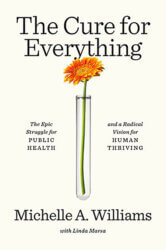
On February 3, 2026, my friend Dr. Michelle A. Williams published the most important healthcare book in recent memory. “The Cure for Everything: The Struggle for Public Health and a Radical Vision for Human Thriving” is essential reading because it makes the broader case that improving America’s declining population health requires far more than making healthcare services more accessible, affordable and effective.
 Michelle’s life story mirrors that of many enterprising immigrants who land on America’s shores. Her family emigrated to Bayside Queens, New York, from Jamaica when Michelle was a girl. Her parents worked 16-hour days at multiple jobs and saved enough to start a dry cleaning business. They pushed their talented daughter to excel at school and pursue the American dream. This led her to Princeton, Tufts for graduate school, an academic career, a long-tenured deanship at the Harvard School of Public Health, Stanford, and the writing of this book.
The young Michelle loved science and thought she wanted to become a doctor. At Princeton, she discovered that she abhorred the sight of blood. As the clinical door closed, Michelle embraced public health as her life’s calling. She is poetic in describing its capacity for advancing human potential,
What is public health? To me, public health is where health science is translated into policies and laws to support the optimal development of people everywhere: the work of protecting, promoting, and preserving humanity’s capacity to thrive. Public health is based on a vision of social justice that sees health as a universal right and a public good. In medicine, physicians treat individual patients. In public health, we see our patients as whole populations. It is a big tent, with room for practically every social and biological science to come together. Public health is public wealth.
But what’s most inspiring about public health is this: Its remarkable history shows us that extraordinary progress for humanity is possible. While we rightfully celebrate feats like mapping the genome, splicing human DNA, or finding better therapies for cancer or heart disease, these triumphs of medical science are dwarfed by the achievements of public health. Over the past century, public health has fueled our collective great escape from a world of unnecessary suffering and early death.
Where do I sign up! “The Cure for Everything” is a magisterial work that chronicles public health’s all-encompassing power to transform societal wellbeing for everyone. The book’s narrative traces the history of public health through the individual triumphs of public health “heroes,” including John Snow, W. E. B. Dubois, Alice Hamilton and Frances Perkins.
Here’s the best part: Investing in public health is cost-effective. Not only do healthier populations require less high-cost medical care, they also create communities that are more productive, equitable and happier. Win! Win! Win!
As I read Williams well-crafted manuscript, I found myself comparing public health to a self-learning “intelligence platform” that collects and analyzes systemic data to design applications that improve a population’s health outcomes.
In this context, better sanitation, vaccinations, humane working conditions, effective maternal and child care, affordable housing, fair employment, good schools, cleaner environments and reduced gun violence are “apps” that work independently and together on top of a strong public health platform to extend lifespans, enrich living and expand human potential. This happened during public health’s golden era (1880 to 1920) when U.S. life expectancy increased from 39 to 57 years.
By contrast, clinical care consists of “point solutions” that improve individual wellbeing. Investing in both public health and clinical care are essential to achieve and maintain high-functioning societies. Unfortunately, the United States has starved public health while over-investing in medicine. The result is the U.S. spends twice as much per-capita on healthcare while its people lead shorter, more violent and unhealthier lives. This is particularly true in low-income urban and rural communities.
Take heart. Past does not need to become prologue. Public health really is the cure for all societal ills. Investments in public health multiply societal wellbeing. By following Michelle Williams’ prescriptions, all Americans can get healthier together.

About the Author

Recent Posts