October 27, 2026

If There Are 5 Types of Loneliness, Why Do We Only Have One Solution?
The Pathway to Healing Isn’t the Same for Everyone.
In 2025, the World Health Organization estimated that loneliness costs the U.S. economy $406 billion per year. For reference, loneliness costs our economy 40 times the government’s annual investment in the Rural Health Transformation Program.
Recapturing those dollars offers a sizable opportunity. But to do so, we have to shift how we think about “loneliness.”
In “The Innovator’s Solution,” Clayton Christensen argued that progress in business and science often stalls because of poor categorization. And his observation fits our current loneliness epidemic perfectly. As the 19th and 21st Surgeon General, Dr. Vivek Murthy, highlighted, loneliness is the defining public health crisis of our time.
Yet, despite his declaration in 2023, we haven’t moved the needle on the scale of our epidemic:
- Half of all adults are still lonely.
- Loneliness is a more popular Google search term this year than in any year prior.
- Two-thirds of parents are lonely, as well as 40% of elders and teens.
So, if it’s robbing us of our health and wealth, why does the epidemic rage on?
My latest research reveals it’s because we have the categories wrong. At the same time, I want to be clear that this isn’t a blaming statement. Without shedding light on the loneliness crisis, Murthy wouldn’t have created a movement eager to solve it. But eagerness and effectiveness aren’t the same things.
With better categories, we can chart a more effective pathway to reducing our loneliness.
‘I’m Lonely’ Means Different Things to Different Parents
Because of the long-tail ripple effects of parents’ loneliness — not just on their own health, but on their children’s as well — our research focused on discovering why parents decided to alleviate their loneliness and how they did it.
When it comes to treating loneliness, other research shows what works on average (i.e., CBT, social prescribing). Yet meta-analyses on parental loneliness show that we know little about which interventions work for different types of loneliness. That lack of knowledge explains part of our inability to move the needle on the epidemic.
The results of my own research were unexpected: “I’m lonely” doesn’t mean one thing. For parents, it represents at least five different experiences, each calling for distinct solutions.
That means our one-size-fits-all approach to loneliness, which generally suggests that an individual increase their number of social interactions, isn’t the best fit for every individual. That’s not to say social relationships aren’t good for our health. They absolutely are. They’re just not the best first step for everyone.
Better categories help us match the struggle to the best-fit solution, and our research identified five categories of parental loneliness. Interestingly, two aren’t rooted in a lack of social connection, but instead in a loss of identity. Our findings are visualized below.
Five Categories of Parental Loneliness
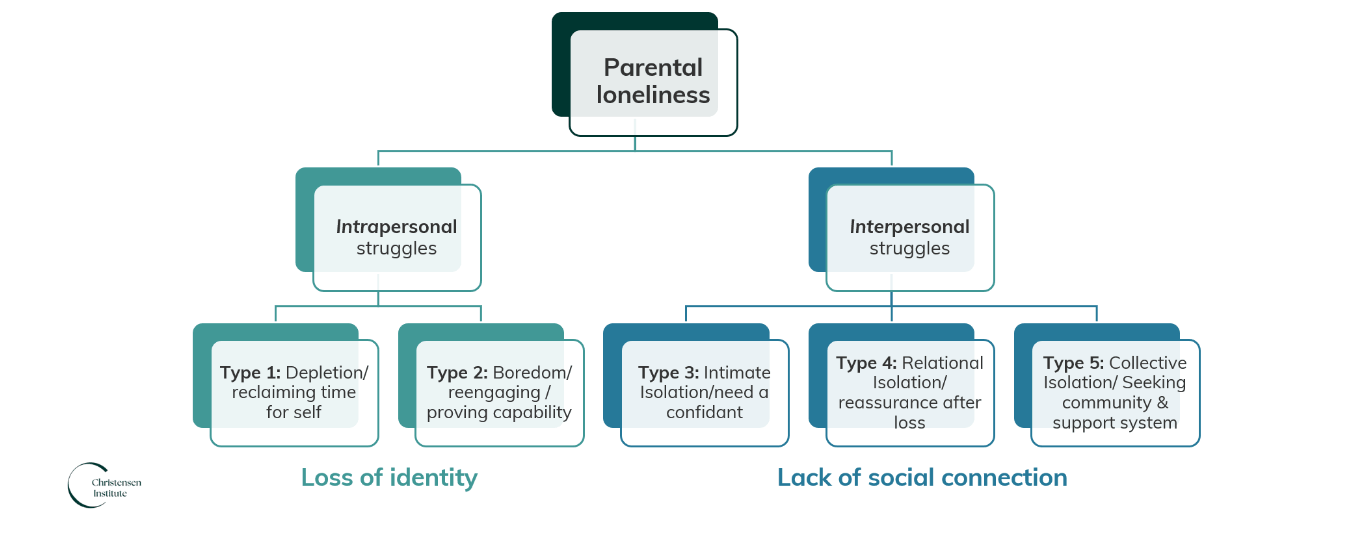
When we better understand a problem’s source and what drives it, we can diagnose it effectively; only then can we intervene in a way that will help. When a provider can identify what drives an individual’s feelings of loneliness, they can engage the patient, activate a behavior change, and improve health outcomes. It creates a virtuous cycle.
But if we keep assuming all loneliness stems from the same struggle, our public health and healthcare systems will keep missing opportunities to serve large swaths of lonely people.
Five Types of Loneliness and How to Treat Each One
In 2024, the Annals of Family Medicine recommended that primary care physicians incorporate an understanding of their patients’ loneliness and social isolation into their practice. That’s an important first step. However, simply assessing whether a patient is lonely won’t reduce loneliness.
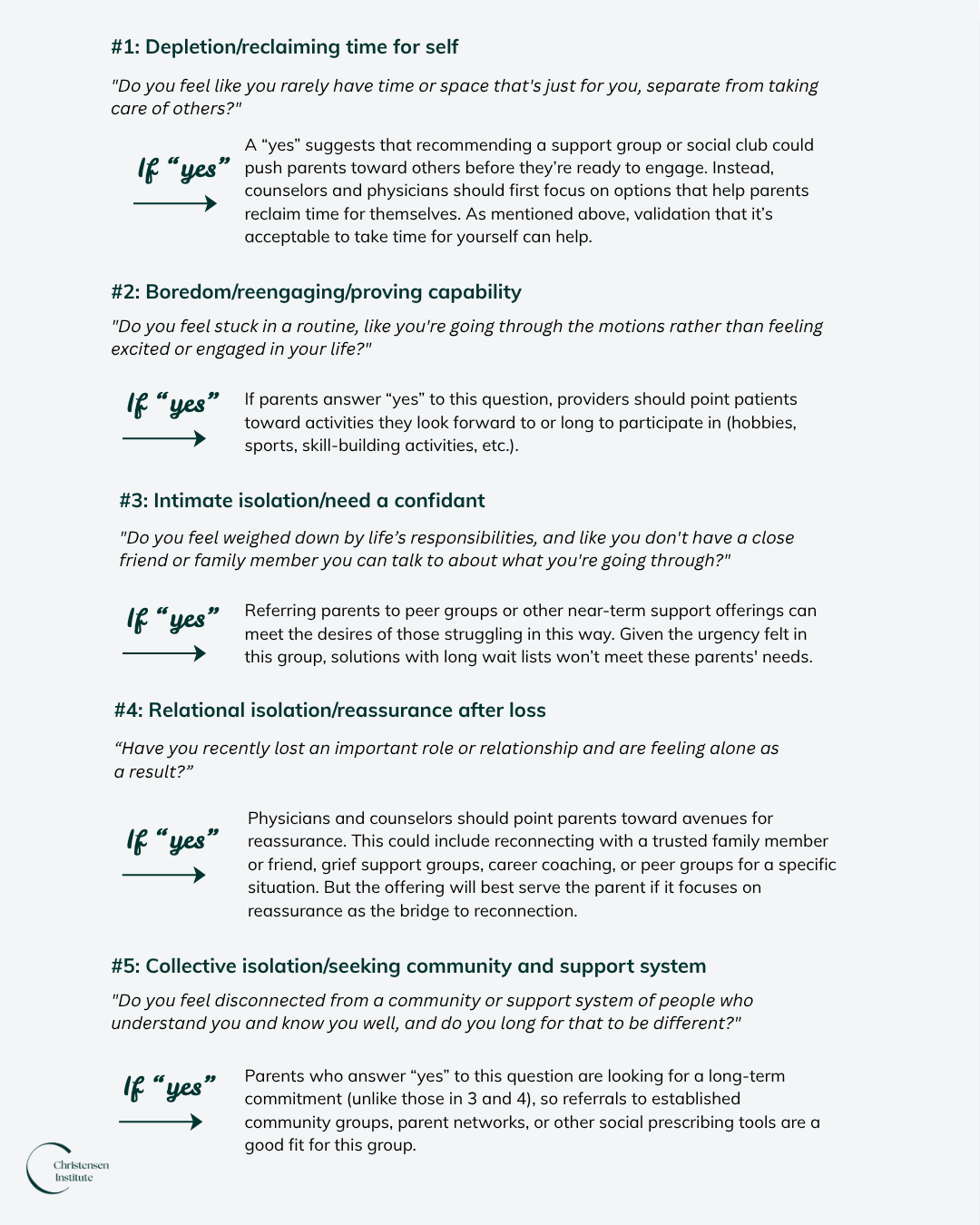
Instead of asking “Are you lonely?” we need to ask “How are you lonely?”
Based on our finding that parents experience loneliness in five different ways, we developed a screener that physicians, counselors or patients can use to determine not only what type of loneliness they’re struggling with, but also the best first step. Because the right social group for a mom struggling to belong isn’t necessarily the right fit for one who needs to reclaim time for herself.
Five Question Test to Identify and Treat Loneliness
Looking Toward a More Connected Future
When I started interviewing parents who’d recently overcome a period of chronic loneliness, I didn’t expect their stories to include struggles with identity. To be clear, I’m a parent, and I understand that identities morph as we take on new roles in life. But I didn’t expect parents to label their struggles with identity as loneliness.
Then I realized that if the prevailing (though incomplete) definition of loneliness is one’s perception of inadequate relationships, it should include one’s relationship with oneself. And for many of the parents we spoke to, that’s how they see it, too.
We can’t make progress on a problem with a foundation of unclear categories. And that’s what our current approach to loneliness is built upon. Our discovery of the five ways parents experience loneliness creates a new approach to categorization that our society desperately needs.
We don’t have to keep incurring the $406B opportunity cost that loneliness costs our economy each year. And we shouldn’t: reduced loneliness represents a massive opportunity for our health and financial futures.
But to change course, we do have to change the questions we’re asking lonely patients. It’s not just “Are you lonely?” but “How are you lonely?” that will yield greater engagement, smarter interventions, better outcomes and, ultimately, dollars saved.

About the Author

Recent Posts