April 8, 2026
Hospital Price Transparency Circa 1926
The deadline for hospitals to comply with CMS’s latest price transparency requirements was April 1. As of last week, hospitals had to post median allowable prices for at least 300 shoppable hospital services in a consumer-friendly format on their websites. Here’s the complete seven-page summary of what hospitals have to do.
As you know, hospitals have been fighting price transparency since Jan. 1, 2021, when CMS published its first set of price transparency requirements to implement a provision in the Affordable Care Act. It’s not necessarily that hospitals don’t want consumers to know what they charge for care. It’s that they don’t want any competitors, health plans and other payers to know what they charge for care. Trade secrets and all that.
If you don’t believe me, you can read the latest semi-annual Hospital Price Transparency Report from PatientRightsAdvocate.org, which tracks hospitals’ compliance with the law and subsequent regulations implementing the law.
The funny thing is, 100 years ago, hospitals went out of their way to tell everyone in their communities how much they charged for their services. Hospitals were completely transparent about their prices.
How do I know?
I’m old, but not that old.
I am old enough, though, to spend an afternoon at the Anatomy of Healthcare exhibit at the Elmhurst Museum in Elmhurst, Illinois. That’s what my wife Jeanne and I did last Friday afternoon, April 3. It’s a shared interest — I’ve been writing about healthcare for 43 years, and she worked in healthcare for 41 years. Afterward, we went out for Mexican food.
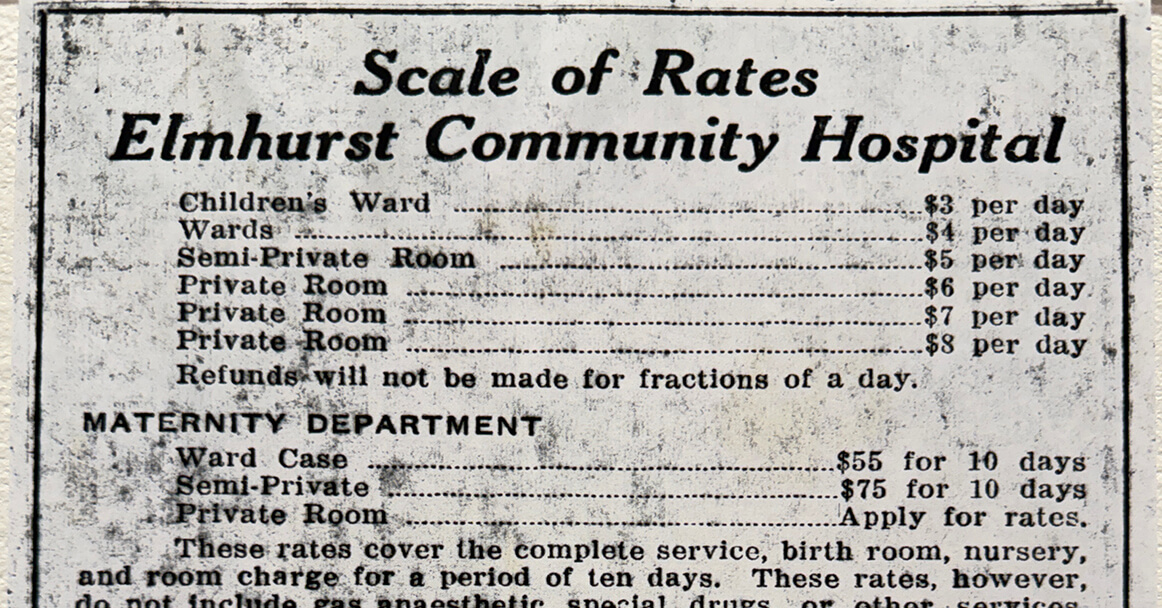
Aside from the company, my favorite part of the healthcare exhibit was the price list from then-Elmhurst Community Hospital circa 1926:
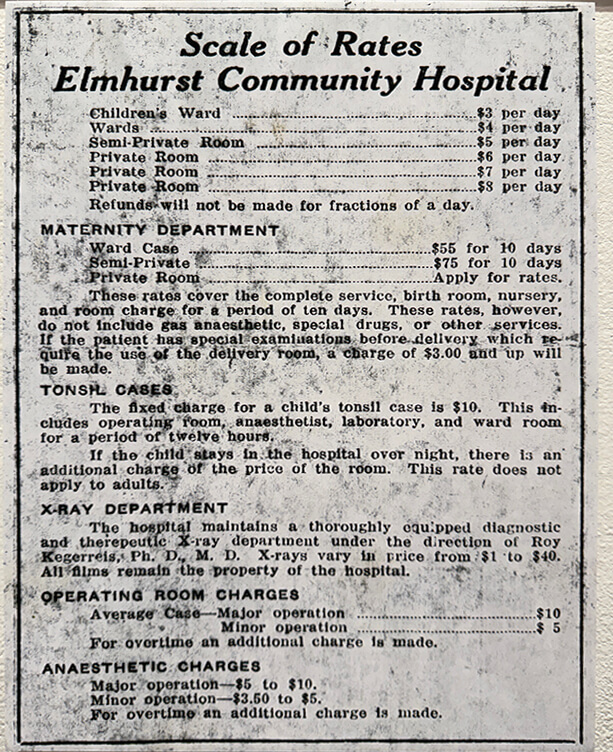
Obviously, the prices are the attention-grabber. A $10 operating room charge for a major operation? An $8 daily charge for a private room? No refunds for partial days, you pikers! This isn’t Cook County.
The hospital also was into bundled payments for services. The $10 charge for a pediatric tonsillectomy included operating room, anesthetist, laboratory and room for up to 12 hours.
For me, though, the attention grabber was the fact that the hospital had a price list, which it called “scale of rates,” and it posted the list for all the world to see. The hospital wanted potential customers to know up front what it would cost for care at the hospital. The hospital had the word “community” in its name, and it clearly felt compelled to tell its community what it charges. The hospital and the community were one. There were no secrets.
Fast forward 100 years and everything’s a secret. As the complexity of the healthcare system grew, so did the distance between hospitals and their communities. Hospitals no longer trusted consumers or anyone else with their price information.
But there was a time when they did. It’s hanging right there on the wall of the Elmhurst History Museum. Price transparency isn’t new. It just got old.
By the way, entry to the museum and the healthcare exhibit is free. It says so right on the front door. It runs through May 3.

About the Author

Recent Posts