May 19, 2026
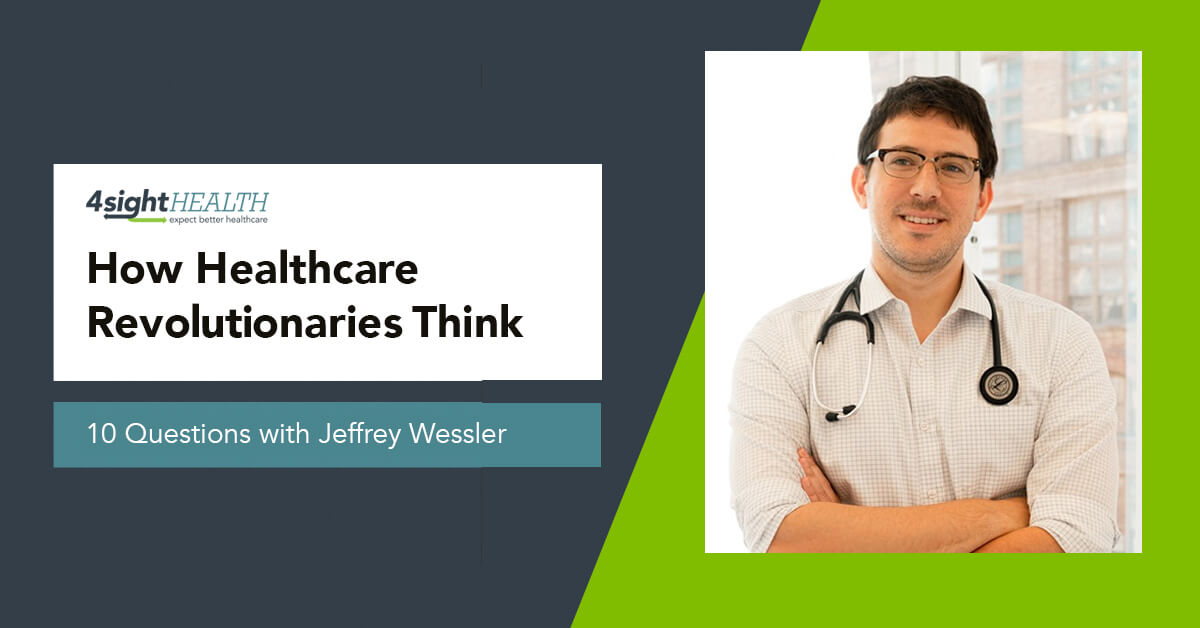
How Healthcare Revolutionaries Think: 10 Questions with Jeffrey Wessler, M.D.
Welcome to the latest installment of 4sight Health’s series, How Healthcare Revolutionaries Think. Our interview series profiles healthcare instigators who believe that outcomes matter, customers count and value rules.
If you’re having unexplained chest pains or heart palpitations, it’s OK to tell cardiologist Jeffrey Wessler, M.D., and ask him what you should do. He much prefers that to seeing you later in the cardiac intensive care unit.
Dr. Wessler believes cardiology should function more like preventive care: routine, risk-based and focused on identifying problems before symptoms appear. But with a nationwide shortage of cardiologists, patients can wait months for an appointment, especially when they are not yet experiencing active symptoms.
Dr. Wessler’s frustration in treating patients whose cardiac crises could have been avoided with better preventive care led him to found New York-based Heartbeat Health in 2016. Heartbeat Health is a national virtual cardiology group that helps payers, accountable care organizations and in-home risk assessment vendors proactively identify, treat and manage patients with moderate to high cardiovascular risk. Its virtual network of more than 1,000 clinicians is licensed in all 50 states.
I asked Dr. Wessler about his journey from chemistry major to public health administration to medicine and finally to healthcare entrepreneur, and how that journey shaped his thinking about how we deliver medical care in the U.S.
You also can listen to my podcast interview with Dr. Wessler and learn more about his interest in public health, his inherited entrepreneurial spirit, his thoughts on the Make America Healthy Again Movement and whether he likes The Pitt.
1. Dr. Wessler, tell me your definition of a healthcare revolutionary?
Wessler: I love this question. For me, a healthcare revolutionary is someone interested in taking a big swing at solving a really important problem. Healthcare has lots of both. What makes someone succeed as a healthcare revolutionary is having the patience to actually get that big swing through. There are lots of good ideas in healthcare that go nowhere. The ability to see something through takes a remarkable amount of patience, understanding and commitment to learning about the market and the problem. Those are some of the ingredients that are table stakes for being a successful healthcare revolutionary.
2. You’re drawing a distinction between someone who swings for the fences and someone who tries to bunt their way onto first base?
Wessler: Even a bunt for a hit would be pretty good these days in healthcare.
3. Agree. Getting on base in baseball or healthcare is an accomplishment. Do you have somebody in mind, past or present, who fits your definition of a healthcare revolutionary?
Wessler: There are a lot of people who I consider to be real mentors and heroes of mine. I’m going to answer with someone who I met during medical school. His name will be familiar to you. Atul Gawande, M.D. He’s an author. He’s a surgeon, first and foremost, turned author. But more importantly, he’s a big thinker about changes that need to happen in healthcare. The thing that stands out to me about Atul is his ability to communicate big problems and solutions that are needed to fix them. Thinking through and being able to convince a generation of young doctors like me and innovators and entrepreneurs to tackle these challenges and go after them in an effective way, I give him a lot of credit.
4. I get it. Who hasn’t read or at least heard about Big Med? He said healthcare could learn a lot from how the Cheesecake Factory restaurant runs. Or his Checklist Manifesto, which said that surgical checklists can improve patient safety? Both were about unexplained variations in healthcare and how to fix them. Enough about what I recall. Let me ask you this. Do you consider yourself a healthcare revolutionary? The next Atul Gawande?
Wessler: I am very cautious about that label for myself, to be honest. The main reason is that I strongly feel that I’m still in the middle of the work. Maybe still at the beginning of the work. We’re eight years in at Heartbeat Health and my journey as a cardiologist-turned entrepreneur. I’m scratching the surface of my understanding of what it takes to genuinely improve heart disease in this country. I’m going to defer that label until something has drastically changed here in the heart health landscape.
5. Fair enough. Let’s dig into your origin story. You earned a degree in chemistry before you made a jump into public health and ultimately into medicine. Where did the interest in chemistry come from? Did someone give you a chemistry set when you were a kid, and you mixed stuff together to see if it would smell bad or blow up? I know I did.
Wessler: There was a lot of science in my household growing up. My mother was a first grade teacher, and what she taught her students about science and the scientific method holds true today. When I found chemistry in college, at a more advanced level, I fell in love with it. I loved following mechanisms, testing hypotheses and working with actual experiments to yield results.
Something I loved, which surprised me when I got to organic chemistry, was how to create a molecule. There are a thousand different possible pathways, and you’ve got to pick the most efficient one. So, 999 of those fail and one succeeds. The failure is discouraging and disappointing, but the one that succeeds makes it all worth it. That feeling when something would go right was my favorite feeling in the world. I find myself today, two different career pivots later, still chasing that successful experiment day after day. I’m not discouraged when it doesn’t work right away. You have to have patience. You have to understand that failure is part of that journey. You have to learn from the things that don’t go well to get to the things that do.
6. Before going to medical school and ultimately becoming a doctor, you got your master’s in public health from Cambridge in the U.K. rather than a program in the U.S. Tell me about that educational experience and how it shaped how you think.
Wessler: I knew the educational experience would be different, but I didn’t know different. Let me give you a comparison. I was at Williams College, a private liberal arts college in Williamstown, Massachusetts, for my undergrad. We would have a test every week and problem sets in the days between those tests. It was constant evaluation and constant judgment of your work against your peers or gold standards.
Contrast that to Cambridge. When I got there, there were courses, yes. But we were told from day one that there will be one examination at the end of the year, and that’s it. And not only that, but it will be completely self-directed. You’ll be writing a thesis, and you’ll have 12 months to work on it. Good luck.
It was about as polar opposite as you could get. You’re going from taking this test to know exactly where you are to it’s all up to you to craft the project you want to work on, to take in the knowledge, to decide how much you’re going to get out of this. It’s up to you. I had to rewire my brain to find my motivation. I won’t find my motivation just by getting a good score on a test. I need to find my motivation by learning the subject, understanding it, and then finding interest in what I was working on.
7. Let’s stick with this jump theme. You jump from chemistry to public health, which is like being in a small room, not talking to anyone, and then walking into a big room and talking to everyone. Then you jump from public health to medicine, which is like being in a big room and talking to everyone, then going back to a small room and talking to one person. What’s up with that?
Wessler: Public health gave me this 30,000-foot view, but at some point, I found myself really wanting to be in the room and be the one interacting with patients at this most vulnerable, frightening moment of their life. I wanted that responsibility. I wanted the responsibility of being a clinician in the overall public health system. That’s where you can create interventions and innovations to help patients within that system. I certainly was drawn to that. My grandfather is a hero of mine. He was a cardiologist and someone I always looked up to. That patient-doctor interaction is a holy space in many ways. To be credible in that holy space, I needed to understand the entire system.
8. Connect the dots for me from public health to cardiologist to entrepreneur. What are you thinking?
Wessler: After med school, I moved to New York, and after my residency, I joined Columbia University Irving Medical Center, which has a really amazing cardiology program. What makes it so amazing is that they take care of some of the sickest patients in the world who are coming in to receive this quaternary-level cardiology care. As you might imagine, the training is pretty tough. You do a lot of overnight shifts, which can be exhausting. Paradoxically, that exhaustion actually leads to some pretty pure thinking about yourself. You evaluate your life and the decisions and choices you’ve made.
I distinctly remember this series of weeks of night shifts in the cardiac intensive care unit. This gnawing thought just kept coming at me. We are getting to these patients way too late. One of the reasons that these cardiac patients end up so, so sick is because we do such a poor job getting them the cardiac care they need in the five years before they got so sick.
I started digging in and doing more research. Not surprisingly, there is an epic failure in this country of getting early cardiology care out to the patients who need it most. It’s not reimbursed well. There’s no incentive structure to do so. Primary care is way overburdened. Patients don’t have the right incentive structure to get in when they need to. So, while I didn’t know yet what solution I’d end up building, I knew this was the problem I wanted to work on. I knew that there had to be a better way of managing heart disease across this country.
9. Did you or do you ever get angry at patients who ended up in your program for not taking better care of themselves? If you just stopped smoking or just stopped eating pizza all the time. Or angry at their doctors for not doing a better job with them.
Wessler: Good question. Those are very common reactions. I found myself getting angry at our system. We have a health system that doesn’t incentivize the right level of care. This isn’t a patient problem. Nobody is to blame when something goes wrong with their health. It’s not a doctor’s problem. Doctors and clinicians are trying incredibly hard to deliver the best care they can. We are all products of the environment that we’re working in. In the case of healthcare, we have an environment that was set up decades ago and not designed around the problems facing our population today. We have to change that system of care if we want to really improve these outcomes.
10. You’re a cardiologist. You’re in a social setting. Do people come up to you and ask, “I’ve had this weird chest pain. What do you think?”
Wessler: I can’t go a day without providing off-the-book cardiology advice to friends, family, neighbors, people at the dinner table next to me in a restaurant. It’s been fun to watch the evolution of the medical advice they want. At first, it was a lot of, “I feel these palpitations or this chest pain. What should I do?” Now I get a lot more of, “What’s your opinion on GLP-1s?” “Should I get my Lipoprotein(a) tested?” “What smartwatch should I wear?” The questions have changed a bit over the years. But I’m happy to answer them. People are always happy to know that they’re not going to drop dead at any moment.
Burda’s Final Brief
I’m 66, and I’m on five different prescription medications. Four of the five pills I swallow each day are to manage my blood pressure and my cholesterol level. I know that I could have avoided most, if not all, of the meds if I had taken better care of myself and my heart when I was younger. There are millions of people like me in the U.S., and we are the people Dr. Wessler wants to keep out of his cardiac intensive care unit with Heartbeat Health. In his own way, he wants to put himself out of business. That’s what makes him a healthcare revolutionary, or at least someone who thinks differently than all the clinicians, administrators and executives who want to maintain the status quo in healthcare. Drop Dr. Wessler a line and tell him how you’re feeling.
Jeffrey Wessler, M.D., is a Virtual Cardiologist and CEO of Heartbeat Health. Read more. Heartbeat Health is centered around one question. “Is it possible to proactively identify, treat and manage moderate and high cardiovascular risk?” Read more.
Read more interviews with healthcare revolutionaries
Healthcare Revolutionary Ann Jordan
Healthcare Revolutionary Swati Mathai
Healthcare Revolutionary Ardy Arianpour
Healthcare Revolutionary Perfecto Sanchez
Healthcare Revolutionary Kemena Brooks
Healthcare Revolutionary Katie Kaney
Healthcare Revolutionary Hal Andrews
Healthcare Revolutionary Julie Murchinson
Healthcare Revolutionary David Terry
Healthcare Revolutionary Matt Marek
Healthcare Revolutionary Mark Engelen
Healthcare Revolutionary Chris Johnson
Healthcare Revolutionary Ramona Wallace, D.O.
Healthcare Revolutionary Alejandro Quiroga, M.D.
Healthcare Revolutionary Samir Goel
Healthcare Revolutionary Marcus Whitney
Healthcare Revolutionary Demi Radeva
Healthcare Revolutionary Michael Pitt, M.D.
Healthcare Revolutionary Rebeckah Orton
Healthcare Revolutionary Dan Trigub
Healthcare Revolutionary Bruce Brandes
Healthcare Revolutionary Lena Chaihorsky
Healthcare Revolutionary David Nash, M.D.
Healthcare Revolutionary Esther Dyson
Healthcare Revolutionary Meghan Conroy
See if your favorites are included in the series and let 4sight Health’s David Burda know who you consider to be a Healthcare Revolutionary.

About the Author
Recent Posts