January 26, 2026

Autonomy’s Golden Moment
I last attended the JP Morgan Healthcare Conference in January 2020, just before COVID locked down the global economy. As many as 20,000 healthcare professionals, including me, converged on San Francisco for this year’s conference. JPM is always a circus. More suits occupy Union Square during conference week than the rest of the year combined.
The biggest difference on the streets between JPM 2020 and 2026 was the ubiquity of self-driving Waymo cars. There were a few test Waymo vehicles during JPM 2020. This year, they were everywhere — clean, quiet white Jaguar sedans running 24/7, offering lower prices than Uber and Lyft for equivalent rides. It’s not hard to imagine driverless ride-share vehicles in greater San Francisco entirely replacing manually driven ones within five years.
Perhaps the Waymo cars caught my attention because I was attending JPM to celebrate the book launch of “Autonomous Healthcare” by Abhinav Shashank, Innovaccer’s founder and CEO. I helped Abhinav with writing his manifesto on building and applying data architecture to eliminate healthcare’s administrative waste and liberate its burdened professionals. I also authored the manifesto’s forward, “Autonomy’s Golden Moment,” reprinted below.
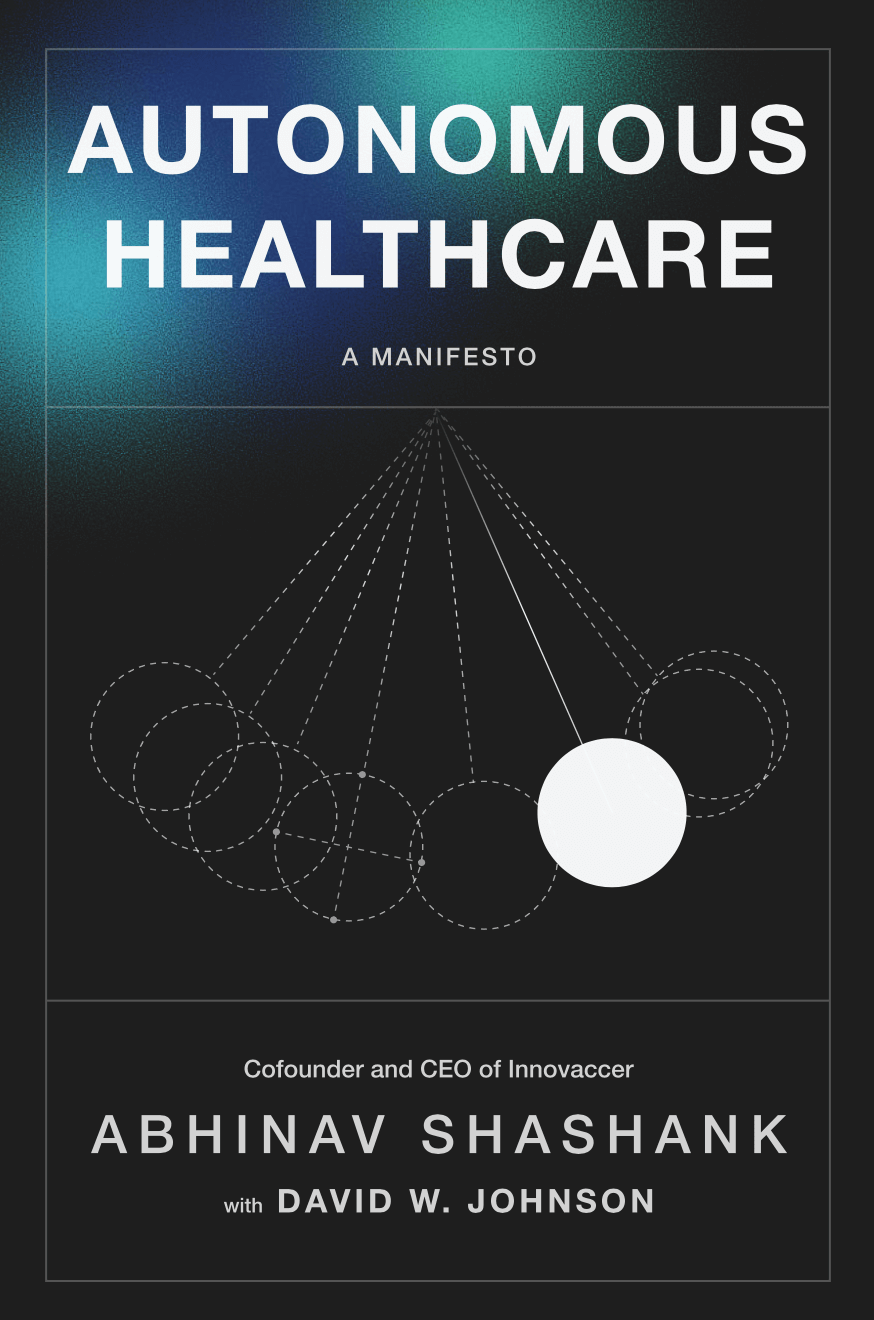
Receive a free digital copy of “Autonomous Healthcare” by clicking on this link and filling out your contact information.
Data interoperability and autonomous systems go together like love and marriage. As the song says, “you can’t have one (autonomy) without the other (interoperability). The good news is U.S. healthcare is on the cusp of achieving health data interoperability this year. Interoperability will unleash a tsunami of autonomous innovations.
Self-driving cars are already here. Autonomous healthcare systems are not far behind. As science-fiction writer William Gibson astutely observed, “The future is already here — it’s just not evenly distributed.” It’s time to embrace autonomous healthcare’s future.
Autonomy’s Golden Moment
Editor’s Note: This is the forward to the new book “Autonomous Healthcare.”
In October 2025, I took a guided art tour of some of Manhattan’s subway stations. A large, colorful glass mosaic titled Blooming took my breath away. Installed in 1996 and located within the 59th Street/Lexington Avenue station, Blooming is a nod by artist Elizabeth Murray to the nearby Bloomingdale’s department store. Beyond its whimsical name and imagery, Blooming also explores the complex relationships between vision, purpose and accomplishment.

Elizabeth Murray with her mural Blooming in 1996. Photo courtesy of the Murray-Holman Family Archive.
Murray’s more serious intent becomes clear in her choice of quotations. The first comes from a 1914 poem titled “Responsibilities” by William Butler Yeats. Captured in the steam rising from a coffee cup, it reads, “In dreams begin responsibilities.” How true that is. Dreams, no matter how promising, can never be realized without commitment, effort and accountability.
Projected to consume 18.6% of the national economy in 2026, the U.S. healthcare system is the largest industry ever created by human beings. At almost $6 trillion in annual expenditure, it dwarfs the $1.6 trillion in revenues attributed by IBIS World to the nation’s second-largest industry, commercial banking.
Of all of healthcare’s glorious dreams, the most powerful and elusive has been the creation of cohesive and personalized digital health platforms. Governments and corporations have invested untold sums in pursuit of this data-driven Holy Grail. The unfortunate result has been a bloated, fragmented and incomplete collection of systems and point solutions that cost too much, fail too often and overwhelm both caregivers and consumers.
Abhinav Shashank is a man who takes his dreams and responsibilities to heart. A dozen years ago, Abhinav found his life’s calling after touring the operations center at a leading U.S. healthcare system. As he describes below, he realized then that healthcare’s data infrastructure lacked intelligence and the ability to act.
I had seen this pattern before in other industries. Data preparation is the cost of entry. Intelligence, however, only emerges when systems are designed to act on that data, to complete work, reduce human effort, and learn from outcomes over time. Healthcare had invested heavily in the first step, but it had barely begun the second.
“Autonomous Healthcare” is the manifestation of Abhinav’s vision, 12 years into his journey to make healthcare’s data systems intelligent enough to liberate caregivers from the drudgery of mind-numbing data entry and repetitive routine work. In five separate acts, his manifesto details healthcare’s data problems, solutions to address them and a step-by-step blueprint for building “intelligent” data architecture. Paraphrasing Shakespeare, autonomous healthcare is the stuff from which Abhinav’s dreams are made.”
The applications, potential and compounding power of machine intelligence to advance diagnosis, treatment and medical discovery are ubiquitous and awe-inspiring. Rather than boil the ocean, Abhinav takes aim at using machine intelligence to reduce the enormous cost, waste and burden of administering healthcare services.
This approach makes eminent sense. Mark Twain once quipped,
If it’s your job to eat a frog, it’s best to do it first thing in the morning. And if it’s your job to eat two frogs, it’s best to eat the biggest one first.
Redirecting Twain’s wisdom, healthcare’s “biggest frog” is administrative waste. Reducing it constitutes a $500-$750 billion opportunity to redirect resources into more productive healthcare activities, including patient care, consumer experience and path-breaking medical research.
The biggest obstacles to achieving healthcare autonomy are political and cultural, not technological. For organizations ready to make the leap, Abhinav counsels that transformational change can only “move at the speed” of trust.
Consequently, he recommends launching autonomy initiatives that first and foremost “eliminate pain.” There are no greater healthcare pain points than those caused by unnecessary and burdensome administrative friction. Reducing administrative “pain” improves employee and customer morale and builds trust. With trust, real change becomes possible.
Here’s the good news. As organizations prove the effectiveness and durability of autonomous systems in reducing administrative waste, they can apply their newfound knowledge and capabilities to tackle even bigger challenges. In this way, healthcare autonomy is the path to more personalized, affordable, equitable and convenient health and healthcare services.
Here’s more good news. 2026 is the year when healthcare autonomy will establish its foundation for growth. Several forces have brought us to this golden moment. I will highlight three:
- Systemic Failure and Rebirth: The current high-cost, treatment-centric U.S. system is neither working nor sustainable. There is clear and broad acknowledgement of this reality throughout the healthcare ecosystem. Enough key healthcare players are investing in the building blocks of a new, more balanced and affordable American healthcare to achieve critical mass.
- Unified Data Infrastructure: Autonomous healthcare requires a comprehensive and unified data layer to inform self-learning platforms to appreciate context and act independently where appropriate. The Trump Administration’s program to achieve full health data interoperability by July 2026 will create the infrastructure needed for intelligence platforms to access unified data.
- Technological Maturity: The intelligence platforms themselves have reached a critical development juncture where they can now ingest gargantuan amounts of unified data on which they can run analytics to gain and infuse insights into applications that engage end-users. Intelligence platforms within other industries have already achieved autonomy. Healthcare is on the cusp.
Abhinav chose to describe “Autonomous Healthcare” as a manifesto for deliberate reasons. It is concise and calls for action. It invites others to join a revolutionary movement to transform healthcare’s data architecture. In so doing, Abhinav is asking leaders across the entire ecosystem to pledge, as he has done, to make autonomous healthcare a reality by 2030.
This seemingly audacious goal reveals an obvious truth: standing still is not an option. Authors Paul Cerrato and John Halamka explain why in this insightful passage from “Transform,” their 2025 book on the “Mayo Clinic Platform and the Digital Future of Health”:
It is not an exaggeration to say that we’re entering a new era in medicine, one in which digital health will profoundly impact the ways you and your neighbors receive patient care and provide medical self-care. While it may be true that medical professionals will not be replaced by the technologies we talk about in this book, professionals who embrace these innovations will replace those who do not.
What is true for medical professionals is also true for leaders of healthcare organizations. There is no more room to straddle between healthcare’s sclerotic past and its transformative digital future. Only executives capable of embracing transformative change and navigating their organizations through the industry’s disruptive wave will retain the right to lead. Autonomous healthcare is coming. It is time to accept and act upon that reality.
The other quote expressed in the Blooming mosaic comes from “The Second Sermon on the Warpland” by Pulitzer Prize-winning poet Gwendoline Brooks. It pours out from a coffee cup with these inspiring words, “Conduct your blooming in the noise and whip of the whirlwind.”
Amid “the noise and whip of the whirlwind,” Abhinav Shashank understands the existential challenges confronting the leaders of healthcare organizations. More of the same strategic approach to the marketplace will yield more of the same dismal human and financial outcomes, or worse.
It is time for a new strategy. Successful leaders will “conduct” their organizational growth in ways that stimulate the blooming of human-machine collaboration. This is the way transformative companies will collectively create a new and better U.S. healthcare system, one that improves the health and well-being of the American people and the communities in which they live.
“Autonomous Healthcare” is the manifesto that makes a compelling case for intelligent data systems. It also provides a blueprint for building them. Here’s my advice to healthcare leaders. Join the movement. Embrace Abhinav’s dream for healthcare autonomy by 2030 and take responsibility for making it happen.
To build better healthcare, we all need to sign the Autonomous Healthcare pledge today.

About the Author

Recent Posts