June 2, 2026

Changing the Innovation Equation in Healthcare
How Today’s Healthcare Transformation Efforts Can Avoid Retail Primary Care’s Fate
A few months ago, I shared two pieces on the Rural Health Transformation Program (RHTP) that assess the program’s apparent insolvency and the best business model for rural environments. Then, at the end of last week, I found myself reading Blake Madden’s recent primary care manifesto article and I had an ah-ha about the connection between what we’re currently seeing in digital health enthusiasm and past innovative primary care models.
If you didn’t read Madden’s piece, the gist of the argument was that the future of primary care must be fundamentally different than the past: substantially lower-cost, constant instead of episodic, appropriately valued for the cost savings it provides and AI-driven. In the piece, he discusses Walmart Health’s downfall and that of other retail primary care models that many (self included) thought would transform healthcare 5-10 years ago.
As I read his analysis, I couldn’t help but notice the parallels between the retail primary care craze and the RHTP, or even CMS’s new ACCESS model. It left me wondering, “Is the RHTP just retail primary care 2.0?”
Off the bat, these new government healthcare programs check a lot of the same boxes that retail primary care models like Walmart Health or VillageMD did:
- There is significant hype around the change they could create.
- The idea of innovation looks good on paper.
- The innovators have noble intentions to revolutionize a struggling component of healthcare in America.
- But perhaps most importantly, the math doesn’t work (specifically the unit economics).
Running through this quick checklist caused me to conclude that, given what we learned from the retail primary care bust, the outcome of the RHTP is highly predictable because the math always wins. It undergirds the profit formula and in a capitalist society, the profit formula is king.
Therefore, a similar outcome is likely for today’s rural healthcare innovations, unless we change the equation and do something differently this time.
What Would Changing the Equation Look Like?
In my first piece on the RHTP, my core argument was that the math doesn’t work: You can’t substantially reduce operating revenues for rural health providers and expect temporary innovation grants (the RHTP) awarded to states to allow rural providers to continue operations for years to come.
But what if the equation changed? What if a disruptive solution were able to enter the market with a significantly lower-cost business model and make the math work?
To change the equation, rural health providers must either lower costs or raise revenues. To continue operating in an era of significantly lower Medicaid funding, increasing near-term revenues is unlikely for several reasons (declining reimbursement, delayed care due to inflation, etc.).
That leaves lowering costs. One of the greatest levers healthcare innovators have right now to lower costs is AI. Importantly, AI wasn’t ubiquitous enough in the early 2020s for retail primary care innovators to use it as a mechanism for substantially lowering care delivery or chronic disease management costs. But today, AI’s potential to sizably lower costs is a very real variable in the cost equation. While its potential to lower costs is high, its track record to do so doesn’t yet exist. More on this in a minute.
So, if we don’t change the equation by significantly lowering costs (the only viable option given the environment), we know how this story ends. It will play out just as it did in retail primary care: Upfront hype over “innovative” approaches to care, followed by innovation investments, followed by innovators not meeting revenue or margin targets, followed by innovators exiting the market, followed by consumers being in the same or a worse position for accessing basic care than they were when the whole cycle started.
Disruptive Innovation Is the Key to Avoiding the Fate of Retail Primary Care
When retail primary care came on the scene, many analysts claimed it had the potential to disrupt primary care. It had potential, but it couldn’t succeed because it didn’t have a sustainable business model. In a 2024 press release about Walmart Health’s closing, the company even stated, “Through our experience managing Walmart Health and Walmart Health Virtual Care, we determined there is not a sustainable business model for us to continue.” (Emphasis: Mine.)
But 2026 is not like 2024 when it comes to AI ubiquity and access. That makes today’s question, “Can AI change the cost equation enough to make rural care sustainable?”
With the RHTP, Congress seems to bet it can, and CMS has already stated they’re making this assumption with ACCESS.
However, to avoid the fate of retail primary care, the innovators participating in RHTP and ACCESS (and the policymakers supporting them) need to ensure that they have all the components of a Disruptive Innovation in place. Without meeting these requirements, they won’t succeed at disrupting rural care or chronic condition management. See below for a reminder of the components required for a successful Disruptive Innovation.
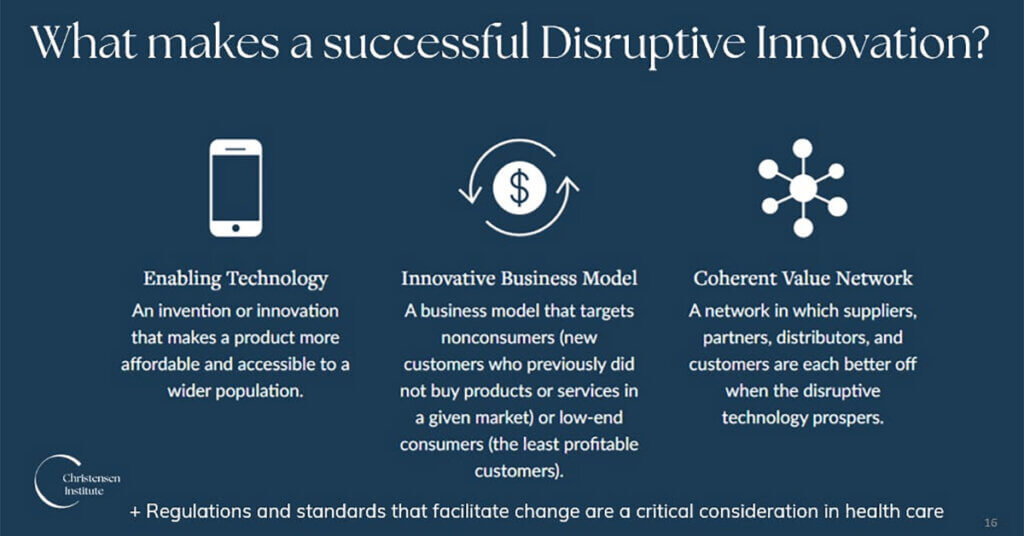
Let’s take a quick look at what we know about the components required for a successful Disruptive Innovation for transforming rural healthcare.
We know that AI is an enabling technology. But many questions remain about whether the remaining conditions are in place. Some are as follows:
- Does consumer-facing AI create value in the medical environment(s) where it’s being deployed?
- Will consumers engage with AI from a medical provider or innovator in a way that will allow them to realize health value or benefit?
- Will regulations be crafted to support the viability, feasibility and desirability of business models?
- Does AI save the amount of money that analysts currently project it can?
All of these questions are critical to address because if innovators succeed in lowering costs while simultaneously worsening outcomes, they haven’t created value. They’ve destroyed it. Additionally, if the industry is going to capture the cost-saving value of AI while protecting humans (an ethical necessity), thoughtful regulation isn’t a nice-to-have. It’s a foundational requirement.
At the end of the day, the only way rural healthcare innovators in 2026 and beyond will avoid the fate of retail primary care is to test, launch and scale Disruptive Innovations. Efficiency and sustaining innovations simply won’t be enough in our current financial situation. And to build a Disruptive Innovation that succeeds, innovators and lawmakers alike must ensure the conditions for success can be met.

About the Author

Recent Posts