July 7, 2026
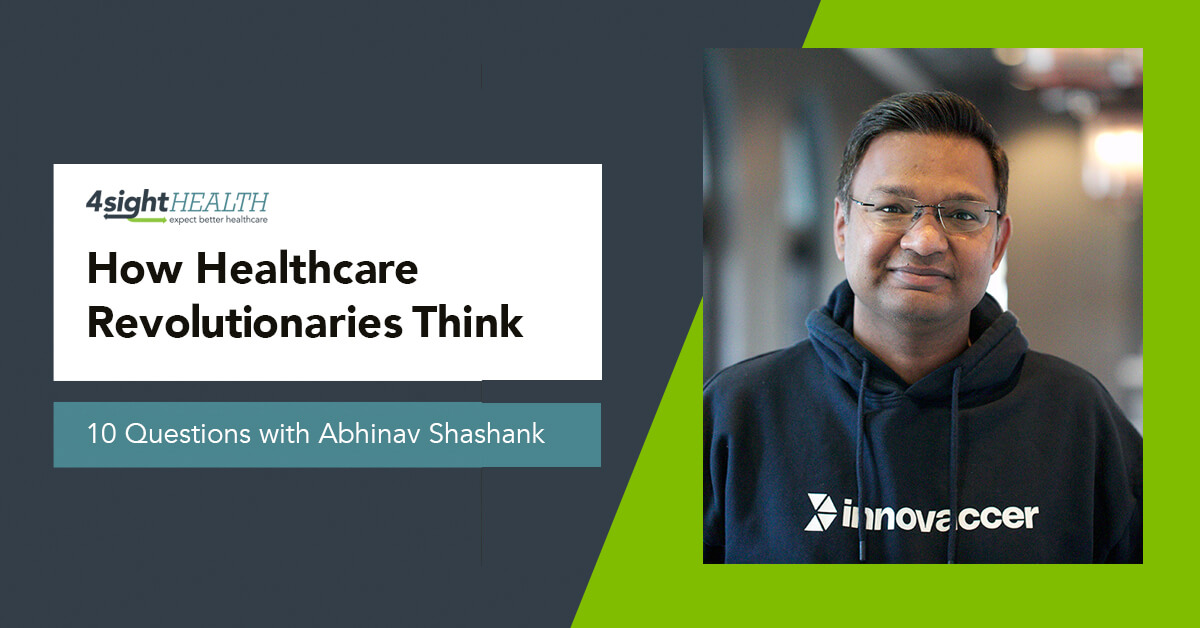
How Healthcare Revolutionaries Think: 10 Questions with Abhinav Shashank
Welcome to the latest installment of 4sight Health’s series, How Healthcare Revolutionaries Think. Our interview series profiles healthcare instigators who believe that outcomes matter, customers count and value rules.
What is Innovaccer? One answer to the question is easy. Innovaccer is a San Francisco-based healthcare technology company that works with various healthcare industry segments to unify their fragmented or siloed data or data sets within one organization or across an enterprise to give users insights into how to improve their administrative, clinical, financial and/or operational performance.
The more complicated answer to the question, and the one I subscribe to, is that Innovaccer is whatever co-founder and CEO Abhinav Shashank thinks Innovaccer is that day. That’s not necessarily a bad thing. In fact, I think it’s a good thing. How Shashank thinks about healthcare is constantly evolving as he tries to match Innovaccer’s capabilities with the constantly changing needs of a constantly changing healthcare system. Not to mention constantly evolving technologies like artificial intelligence. Oh, and healthcare’s constantly changing political and regulatory environment.
It’s a learning curve that Shashank clearly intends Innovaccer, founded in 2014, to stay ahead of.
To wit, on May 15, Inc42 reported that Innovaccer laid off 340 people, or about 25% of its workforce in the U.S. and India as Shashank transitioned Innovaccer into an AI company. About a week later, Innovaccer announced its acquisition of CaduceusHealth, an AI-powered healthcare revenue cycle management company. Then on June 4, Shashank announced on LinkedIn that Innovaccer hired YiDing Yu, M.D., as its new chief product officer. Yu is the former chief product officer and chief medical officer at Olive, the once “high-flying” healthcare AI startup that shut down in October 2023.
Shashank’s ability to see what comes next puts him in the opposite corner from most healthcare executives who resist change or rely on traditional strategies and tactics and/or the entrenched healthcare industrial complex to solve or erase today’s, and, more importantly, tomorrow’s business problems. What Shashank sees specifically is a three-layer tech stack — data, intelligence platform and apps — that’s broadly applicable to solve any healthcare challenge.
Effectively building up and out can’t happen without deep roots or a core set of beliefs. One is Shashank’s belief in the AI-driven, autonomous future of healthcare. He shared that belief with the world in his self-proclaimed manifesto, Autonomous Healthcare, published in January. David W. Johnson, founder and CEO of 4sight Health, wrote the foreword to the 52-page paper.
What other core beliefs and experiences drive the buildup and out? That’s what we talked about in my recent interview with him for this series.
You can also listen to my podcast interview with Shashank and learn more about why he thinks healthcare is behind other industries in terms of technology-driven innovation, his earlier work using technology and data to transform other industries and why he’s grateful to every Innovaccer employee — past, present and future — who are along on his ride.
1. Abhinav, let’s start with the question we ask everyone in this series, and that’s for your definition of a healthcare revolutionary. If you wrote that dictionary entry, what would you say?
Shashank: That’s a good question. A healthcare revolutionary, in the current age and time, is someone who thinks about making healthcare work as healthcare and not as a series of administrative tasks. No one went to med school to study how to fill out a form, what a coding framework looks like. Because of all of the rules and regulations and requirements we’ve put in place, those are the most important tasks in healthcare right now. Taking care of the patient has become secondary to all of the other stuff that’s around the patient. Few people are building technology for the betterment of the patient and to drive better care. This is insane. What does a healthcare revolutionary in today’s day and time need to do? They bring the patient back to the center of healthcare.
2. Who’s doing that right now? Or has done it in the past? Given your definition, who’s your favorite healthcare revolutionary past or present?
Shashank: I’m picking an organization, not a person. I’m a fan of Kaiser Permanente. The Kaiser model makes sense to me. Kaiser’s integrated care model lets you remove some of the barriers I mentioned. Give me a certain amount of dollars, and I promise I will take care of you. That’s the simple promise that Kaiser basically makes, right? I am your partner in keeping you healthy. That’s the financial incentive for Kaiser — making sure that the patient is healthy. Fee-for-service models are incentivized to treat you if you are sick. More sick patients the better. Sicker patients the better. Kaiser makes more money when you stay healthy. That’s the model healthcare should basically evolve towards.
3. Do you consider yourself a healthcare revolutionary? I know, it’s a tricky question. But I’ll lay it out there for you.
Shashank: I would just say, as a company, we’re striving to be a healthcare revolutionary. We want to make the changes that are required to move the patient back to the center of healthcare. But we are very early in our journey. So put us in the “striving to be revolutionary” bucket.
4. Let’s dig into your origin story. Tell me about your family. What did they do for a living? Do you have any siblings? Were any of them involved in healthcare in any way?
Shashank: Let’s go back two generations. My grandfather was the dean of one of the largest universities in India. That made us all education-focused. We knew the importance of a good education. My dad and mom and all their siblings were in public service of some kind. My dad at various points in his career ran the departments of education, finance and treasury in one of the largest states in India. My mom has a Ph.D. in clinical psychology. She went into public service.
The theme that runs through all of that is we all have to do something for the public good. That is your purpose of being here. Doing something for the larger good. You can do that by being an entrepreneur. Being an entrepreneur with a purpose. That also creates employment and opportunities for others. No one in our family really cares about how much money you make. They care that you’re doing something for the public good.
5. When you’re sitting at the dinner table, your parents aren’t asking you how much money you made today. They’re asking you who did you help today. Those are the conversations that you’re having.
Shashank: Yeah, exactly. No one ever makes a lot of money in public service. But growing up, I saw how what my mom and data did help hundreds of thousands of kids get an education. Their education led to employment opportunities that flipped the lives of their families in the right direction. More than a few of those kids actually ended up starting their own small businesses.
That was a large part of my motivation to do something entrepreneurial. Early in my life, I saw how an entrepreneurial endeavor changed the lives of a lot of people around you. I’m a firm believer in that. Like the promise of America to a certain extent.
 6. How did your parents react when you became an entrepreneur?
Shashank: Like I said, everyone in my family, including my mom and dad, wanted and expected us to go into public service. My mom came to the inauguration of one of our new offices after we had 400 or 500 people. She said, “Now that you’ve done this, would you want to do public service now?” Even today, that message continues to come in loud and clear.
7. They’re still on you about that. That’s great. Parents never stop being parents. You’re a parent. You have a young daughter. What do you want her to be when she grows up?
Shashank: I want her to become President of the United States. That’s the ultimate public service job. It’s the same hope that my parents had for me. They wanted me to apply myself and do something that mattered in the world. I want the same for my daughter. That could be a doctor, an engineer, a lawyer. I want her to apply herself to a purpose that she believes in. That would make me happy as a parent.
8. Let’s jump back to healthcare from parenting. You’ve experienced the healthcare system in India. You’ve experienced the healthcare system in the U.S. What are the lessons from those experiences that give your work, in your words, purpose today?
Shashank: Healthcare is far more accessible in India than it is here. We started as a horizontal company. Our technology could be applied across Fortune 500 companies. We had a number of companies using the technology that we were building. Then we started working with our first healthcare client. It was an ACO [accountable care organization] in Des Moines, Iowa. I never heard of Des Moines. The technology that it was using was so simple, so basic and so behind other industries, we decided to shut down 90% of our business at that point to focus just on healthcare.
One of the most meaningful problems to solve in healthcare is access. Access here, compared with India, is so hard. I had a dislocated kneecap. It took me four weeks to get an appointment with an orthopedic specialist. By that time, it had healed already. We spend more than $5 trillion on healthcare in the U.S., which is more than India’s GDP, and we still can’t get care when we need it. This is what I mean when I talk about moving the patient to the center of care by knocking down all these barriers we’ve created.
9. What’s it like to work for you? I’m sitting at a desk, I’m doing my thing, the phone rings or I get an email or text from you, am I happy, sad, afraid? Tell me about your management style.
Shashank: There are a couple of things that define what it’s like to work here. First, what we’re doing is incredibly hard. The problems in healthcare are not easy problems to fix. Before we hire someone, I tell them that what we’re doing is not easy for us, and it won’t be easy for you. There are easier things you can do with your life to be happy and to earn a living. We’ve consciously chosen hard problems to solve. You need to be ready for that.
Second, we always want to do the right thing based on the data. I’m a technologist by heart. I’m a very data-driven person. Talk to me about the numbers. Between English and math, it’s math. What are your metrics? Give me your top one, two, three metrics max. Are your metrics moving in the right direction? If you can’t quantify the outcome of your work, you never know if you’re good at it or not. People who love working with me and whom I love working with are very analytical and quantitative. We measure everything because building a successful business is a systems engineering problem.
10. Well, here’s a subjective question for you that I hope will help quantify how you think. What’s something that people don’t know about you? Something you do in your free time? A hobby?
Shashank: I love Bollywood movies. I like Indian actors like Shah Rukh Khan and a couple of others like Rajinikanth. We have a joke that says Chuck Norris is to the U.S. like Rajinkanth is to the universe. I love superhero movies.
Burda’s Final Brief
I’m not a visionary. I’m not a risk-taker. I’m not a charismatic leader. I’m not an entrepreneur. I’m not an innovator. I’m not a disruptor. I’m not a rock star. And no one follows me wherever I go. In sum, I’m not Abhinav Shashank. But that’s OK because Abhinav Shashank is Abhinav Shashank. I don’t have to be any of those things because Shashank already is. How hard he’s willing to work and how much he’s willing to sacrifice to improve the healthcare system for people like me make him a healthcare revolutionary. He is, as his parents hoped, in public service. And if his daughter ever runs for president, I’ll vote for her.
Abhinav Shashank is the Co-founder and CEO of Innovaccer, where he is driving the company’s mission to transform healthcare into a connected, data-powered ecosystem. His leadership has helped unify over 54 million patient records and secure more than 100 industry recognitions, positioning Innovaccer as a leading force in population health and value-based care. A prolific healthcare thinker and strategist, Abhinav has been featured in Forbes, Fortune India, Modern Healthcare, and other global platforms for his visionary work.
Innovaccer is a healthcare technology company focused on helping healthcare organizations unify fragmented data and use artificial intelligence to improve clinical, operational, and financial performance. Founded in 2014 and headquartered in San Francisco, Innovaccer serves health systems, payers, government agencies, and life sciences organizations through a cloud-based platform that integrates data from electronic health records, claims systems, labs, pharmacies, and other sources. Its core mission is to create a connected healthcare ecosystem where providers can access real-time insights, automate workflows, and improve patient outcomes.
Read more interviews with healthcare revolutionaries
Healthcare Revolutionary Jeffrey Wessler, M.D.
Healthcare Revolutionary Ann Jordan
Healthcare Revolutionary Swati Mathai
Healthcare Revolutionary Ardy Arianpour
Healthcare Revolutionary Perfecto Sanchez
Healthcare Revolutionary Kemena Brooks
Healthcare Revolutionary Katie Kaney
Healthcare Revolutionary Hal Andrews
Healthcare Revolutionary Julie Murchinson
Healthcare Revolutionary David Terry
Healthcare Revolutionary Matt Marek
Healthcare Revolutionary Mark Engelen
Healthcare Revolutionary Chris Johnson
Healthcare Revolutionary Ramona Wallace, D.O.
Healthcare Revolutionary Alejandro Quiroga, M.D.
Healthcare Revolutionary Samir Goel
Healthcare Revolutionary Marcus Whitney
Healthcare Revolutionary Demi Radeva
Healthcare Revolutionary Michael Pitt, M.D.
Healthcare Revolutionary Rebeckah Orton
Healthcare Revolutionary Dan Trigub
Healthcare Revolutionary Bruce Brandes
Healthcare Revolutionary Lena Chaihorsky
Healthcare Revolutionary David Nash, M.D.
Healthcare Revolutionary Esther Dyson
Healthcare Revolutionary Meghan Conroy
See if your favorites are included in the series and let 4sight Health’s David Burda know who you consider to be a Healthcare Revolutionary.

About the Author

Recent Posts