November 17, 2026
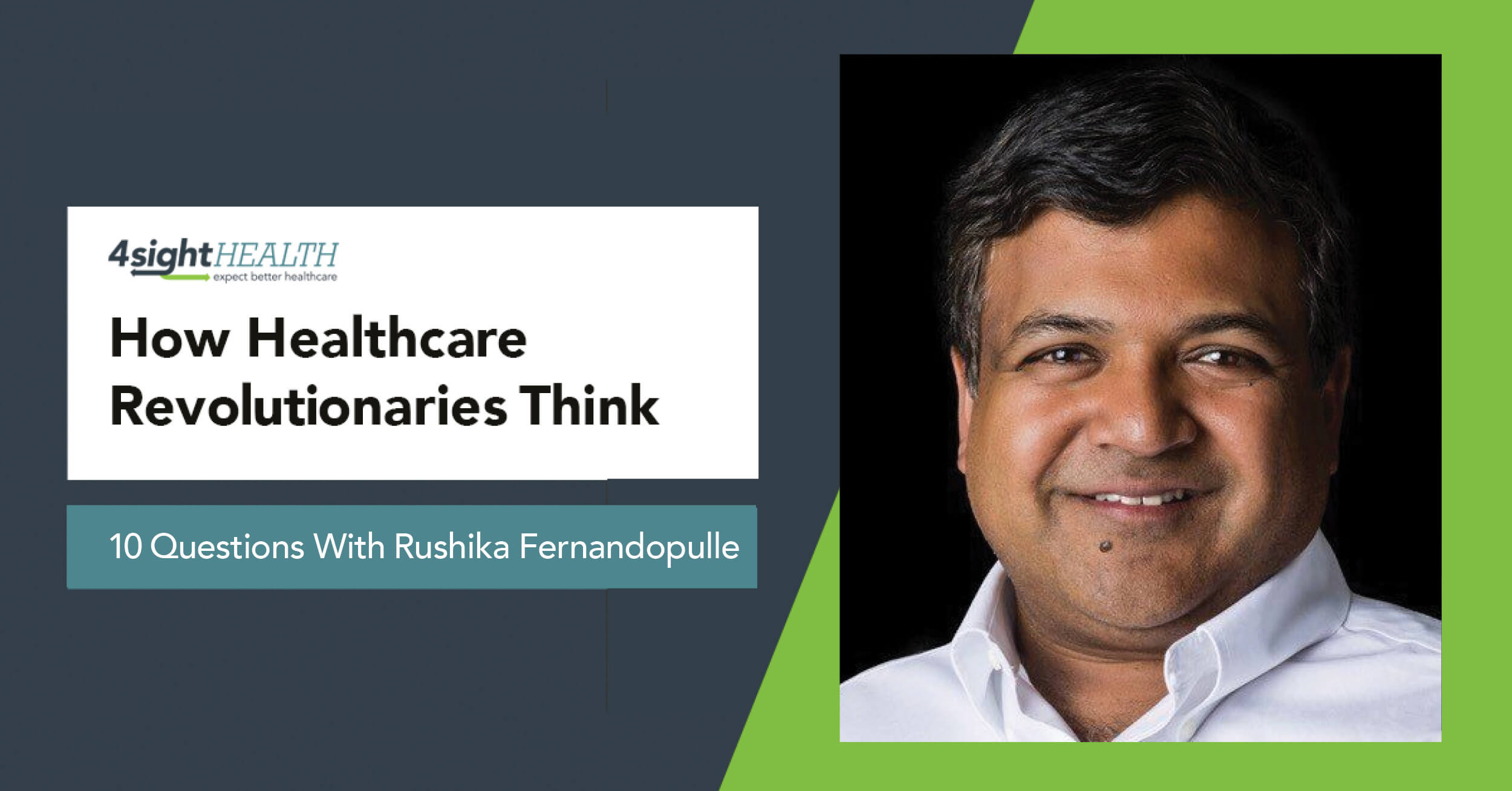
How Healthcare Revolutionaries Think: 10 Questions with Rushika Fernandopulle, M.D.
Welcome to the latest installment of 4sight Health’s series, How Healthcare Revolutionaries Think. Our interview series profiles healthcare instigators who believe that outcomes matter, customers count and value rules.
When you think primary care disruption, you think Rushika Fernandopulle, M.D. Principal, Renaissance Health. Co-founder and CEO, Iora Health. Chief Innovation Officer, One Medical. Today, co-founder and CEO, Liza Health. But this piece isn’t about what you think. It’s about what Dr. Fernandopulle thinks, and why he thinks that way. And why I think healthcare consumers need more people like him.
I spoke with Dr. Fernandopulle as part of our How Healthcare Revolutionaries Think series. I asked him about why it’s taking so long for the healthcare industry to re-invent primary care as its been promising to do for decades. One reason? People are afraid to get fired.
You also can listen to my podcast interview with Dr. Fernandopulle and hear his thoughts on patient movements, chief innovation officers, public speaking, and artificial intelligence.
1. We’ll start where we always do with this series, Dr. Fernandopulle, and ask you for your definition of a healthcare revolutionary. What’s yours?
Dr. Fernandopulle: I’m inspired by the famous quote from Robert F. Kennedy. Not the current cabinet official. The brother of JFK. He said this all the time, but it was first coined by George Bernard Shaw, the playwright. It’s, “Some men see things as they are and say why. I dream things that never were and ask why not.” There are many people in healthcare simply working to prop up the current system. How do I build things to help existing people? There are very few who are revolutionaries who actually are trying to change the system. They’re asking why not? That’s my definition of a healthcare revolutionary.
2. What moves a person from one square to another? What change has to happen? What’s the secret ingredient?
 Dr. Fernandopulle: The main thing is courage. It’s not a secret that the current system doesn’t work and doesn’t work for lots of people. Unfortunately, the problem with healthcare is that it’s too easy to make money doing more of the same. The harder thing, the much harder path, is trying to break the system and do something differently. Right now, we have a lot of people who lack the courage to change.
3. Do you have a favorite healthcare revolutionary past or present who showed or shows the type of courage that you’re talking about?
Dr. Fernandopulle: I have lots of them. Don Berwick, M.D., who was a mentor of mine back in the 1980s. Don started pushing hard on patient safety and quality improvement. The late Paul Farmer, M.D., who started Partners in Health, the global social justice organization that brings the latest medical advances to the poor and underserved around the world. At the top of my list is a person most people have never heard of, and that’s a guy named Paul Uhlig, M.D. He’s now a cardiothoracic surgeon at Wesley Medical Center in Wichita, Kansas.
When Paul was working in New Hampshire years ago, he decided that the way they took care of people was awful. Instead of the usual where the surgeon would show up at rounds at 5 a.m. when the patient was sleeping, he said, “I’m going to change this and create a new model where I’m going to schedule a time at 10 a.m. for you. You can have your family come in. I will walk in, and the whole team will discuss your care. We have this big board, and we’ll talk about what went well, what went didn’t go well. We’ll let you see your own X-ray. We’ll let you look at your own chart.”
It was amazing, and he had amazing outcomes. Length of stay dropped. His complication rate dropped. Patients liked it better. You can imagine the end of the story, though. His colleagues had patients seeing their neighbors getting this approach and asking, “Hey, how come you don’t do this?” The other cardiac surgeons were furious, and Paul ended up getting fired. Unfortunately, that’s the end of the story or at least part of the story for a lot of these revolutionaries. They threaten the status quo and get fired.
4. Do you consider yourself a healthcare revolutionary? Are you OK with getting fired?
Dr. Fernandopulle: I hope so. I’m not afraid of getting fired. My definition of work is trying not to prop up the system but to change it. Like I said, doing that doesn’t always make you new friends. We started our first practice way back in 2003. We were doing crazy things like not letting people wait and emailing and texting them, giving them access to their medical records. We were accused, literally, of raising patient expectations. You’re making the other practices look bad. Do you understand you could upset the status quo? I said, “Yes, that’s exactly what we’re trying to do.” But we got kicked out of networks. We had all sorts of things happened to us. I often tell people, if you’re not pissing anyone off, you’re not innovating. It’s that simple. If everyone likes what you’re doing, you’re just helping maintain the status quo.
5. It’s funny what you said about not making people wait. That’s a basic tenet of any good business, right? Waiting is what drives people crazy.
Dr. Fernandopulle: It’s a different mindset. We said we should value our patients’ time as much as we value ours. Most practices are optimized for the doctor’s time and don’t give a wit about the patients. As opposed to saying, “No, their time is as or more valuable than ours. We should restructure our practice to value their time.” That’s the difference.
6. Let’s talk about reinventing primary care. It seems I’ve been typing those words for 30 years or more. Why is it taking so long to reinvent primary care?
Dr. Fernandopulle: Well, the short answer is that most of the people who talk about reinventing primary care aren’t really reinventing it. They’re tweaking it. They think making all these little reforms eventually will lead to system transformation. I think that’s wrong. The system is rotten to the core, and we have to restart it.
7. That’s the short answer. What’s the long answer?
Dr. Fernandopulle: I ran this inter-faculty health policy program at Harvard. What we used to do was call all stakeholders together — heads of the hospital system, health plan, medical group, employer and drug company. They would come up with a plan to fix healthcare or fix primary care. It was an utter waste of time. These are the same people who came up with the current system. Guess who wasn’t at the table? The patient.
It’s very simple. You have to pick who you’re going to work for and ignore the rest and optimize for that. If other people are with the program, that’s great. But if they’re not with the program, then it’s not your problem, right?
They play in this unwinnable box. At Iora, we talked about changing the four Ps. You have to change the payment model, change the process, change the platform, which is the technology, and change people, which is culture. You need all four. If you try to change one without changing the others, the thing falls apart. That’s what most people try to do and why they fail. You need to start from scratch. Don’t try to please everyone. Decide who you want to work for and then change everything. That’s what you need.
8. You mentioned Iora Health. Your new primary care practice is called Liza Health. Those are unusual names. You didn’t go with Rushika Health or Main Street Health or something a little more obvious or common. What’s your thinking behind what you call your ventures?
Dr. Fernandopulle: I wanted names that were short. Easy to spell. That we could imbue meaning to it as we go. Not Health Quality Partners or Quality Health Partners. I wanted to build the practice and make the name stand for something. Iora means pure. But it’s also this little yellow bird from Sri Lanka, which is where I’m from originally. I was in Sri Lanka visiting, and a friend took me birdwatching. We saw this little yellow bird and I was like, “What’s that?” “Oh, that’s an iora.” I was like, “That’s a cool name.” Four letters. Obviously, there’s no other ioras here.
With Liza Health, we’re building a new AI-enabled model of care. I wanted a human name. Eliza was the name of one of the first medical chatbots. So, it’s a little bit of an homage to that. A little bit of an homage to that. So, we just name it and then, like I said, imbue meaning into the name as we go.
9. Maybe that’s a good segue to my next question about Premera, which is a made-up name. Premera is the Blues plan serving Washington and Alaska. You’re on the Premera board. You’re seeing primary care through the eyes of a health insurance company. You’re also on the board of Families USA, the patient advocacy group. How do these experiences affect how you think?
Dr. Fernandopulle: My mission is really to transform healthcare. Having done this for a long time, I can do that not just through my own work but through outside activities like serving on boards and guiding other organizations. One thing you learn when you try to build new models of care is that there are all these stupid federal rules. If you want to change the system, you also need to change the rules.
Families is a great patient advocacy organization. The only real way to change the current system is with a patient movement. A patient movement can change some of these rules. Families fight for those sorts of things. Like the drug monopolies that pharma companies get when they play with patent rules.
Premera is a great not-for-profit Blues plan. There’s a lot of value in local payers with deep roots in the community. The problem with these big national players is if they don’t like a market, they just leave. But Premera can’t leave. This is our market. I want to learn how to support and transform these payers. I’m trying to get all of these organizations to push the envelope a little bit.
10. You also encourage people to push the envelope through public speaking, which you do a lot of. Why is it important for a disruptor, innovator, entrepreneur to get out there and tell their story?
Dr. Fernandopulle: Remember, David, the mission is to transform healthcare. And remember I said we need movements to do that. My speaking is one way to do both. But lots of entrepreneurs in healthcare are secretive about what they’re doing. They make you sign NDAs (non-disclosure agreements). They have tight non-competes. This is ridiculous, right? This is a huge space. I never think of the other people in this space as competitors. We are fellow travelers.
Burda’s Final Brief
I’ve been working since I was 12. My first job was a caddy at a local private country club. In the 54 years since I first hung a golf bag over my shoulder and lugged it around a golf course for 18 holes, I’ve worked for all kinds of companies and organizations. I’ve worked with all kinds of people. I’ve worked for all kinds of bosses. The best people and the best bosses to work for are those who aren’t afraid. They want to do the right thing for their customers no matter what and regardless of personal career risk to them. That’s how things get done. That’s how things move forward. The worst people and worst bosses to work for are those who are afraid. They’re afraid of getting fired. One step forward, two steps back to cover their ass. Email strings. Paper trails. Pre-meetings before pre-meetings before meetings. Nothing gets done. If it does, it takes forever and produces something safe that won’t raise any eyebrows. Healthcare needs more people who aren’t afraid to get fired. It needs more people like Rushika Fernandopulle, M.D. It’s the only way we’re going to build better healthcare.
Rushika Fernandopulle, M.D. is a practicing physician and former Chief Innovation Officer of One Medical, a leading Advanced Primary Care company based in San Francisco, California. He was co-founder and CEO of Iora Health, the first Executive Director of the Harvard Interfaculty Program for Health Systems Improvement, and Managing Director of the Clinical Initiatives Center at the Advisory Board Company.
Liza Health is a public benefit corporation that offers primary care physicians an operating system to deliver the world’s best healthcare in practices that physicians own and operate. Liza supports both primary care physicians and their patients in setting objectives that incorporate the patient’s perspective, and provides tools to enhance clinical decision making and execution of care delivery, including data access, insights and workflows.
Read more interviews with healthcare revolutionaries
Healthcare Revolutionary Abhinav Shashank
Healthcare Revolutionary Jeffrey Wessler, M.D.
Healthcare Revolutionary Ann Jordan
Healthcare Revolutionary Swati Mathai

About the Author

Recent Posts