September 15, 2026
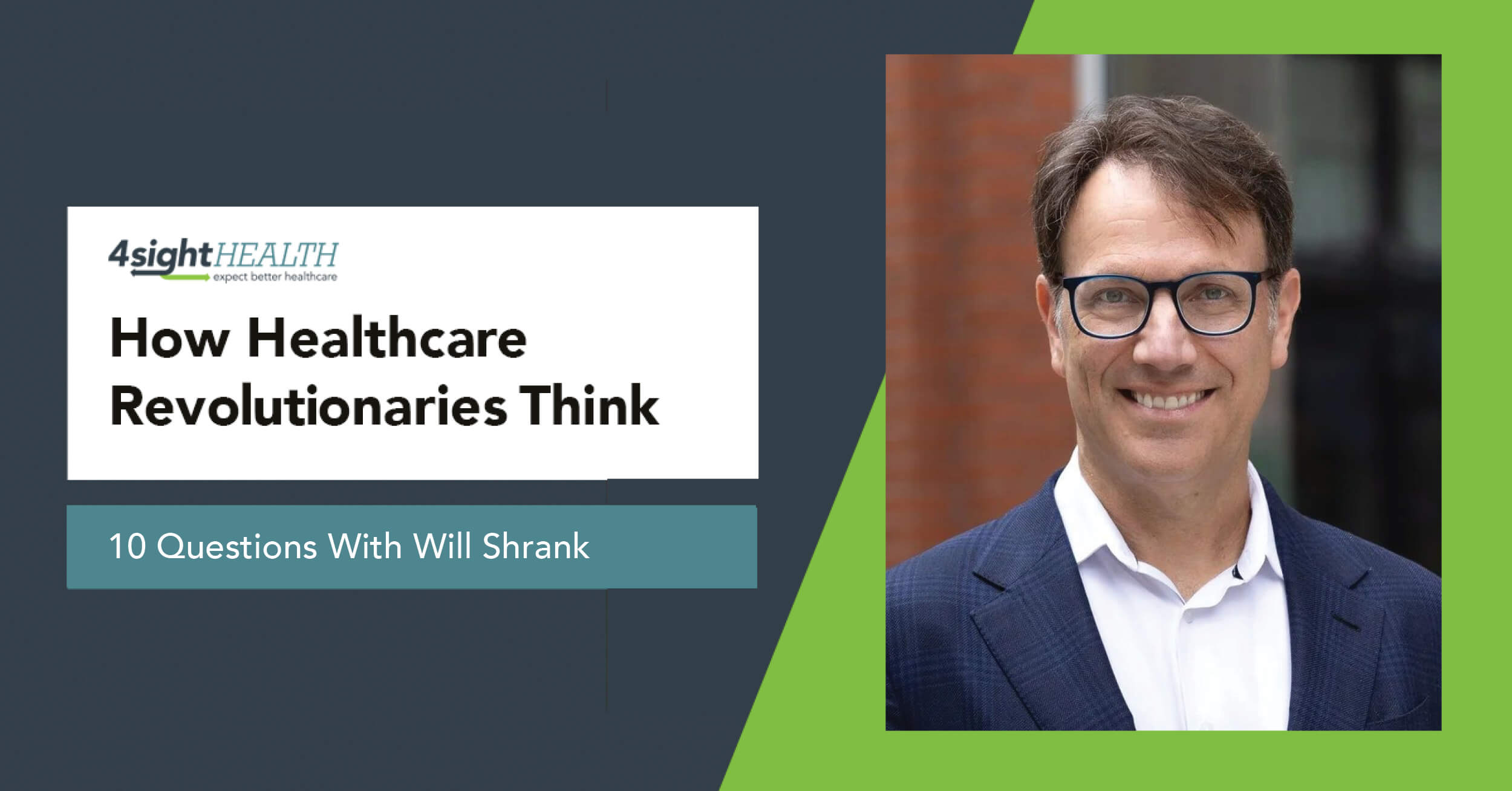
How Healthcare Revolutionaries Think: 10 Questions With William H. Shrank, M.D.
Welcome to the latest installment of 4sight Health’s series, How Healthcare Revolutionaries Think. Our interview series profiles healthcare instigators who believe that outcomes matter, customers count and value rules.
There are two words that dominate today’s discussion over the direction of the healthcare system in the U.S.: affordability and access. Can consumers afford access to medical care and healthcare services they need to keep them healthy or get healthy when they’re sick or injured? The way the healthcare system is currently structured and operates, the answer to that question is less and less likely. That’s especially true for patients with life-threatening medical conditions and diseases treatable only by expensive drug and gene therapies.
There’s another word that starts with the letter A that attempts to solve that challenge: Aradigm Health. Founded in 2024 by physician Will Shrank, M.D., who now serves as CEO, the New York-based firm offers a finance and delivery platform that connects employers, insurers, manufacturers and providers to facilitate patient access to high-cost cell and gene therapies. Affordable access is one of the start-up’s three pillars.
I spoke with Dr. Shrank as part of our How Healthcare Revolutionaries Think series. I asked him about his experiences working at the Center for Medicare and Medicaid Innovation (CMMI) and at three health insurance companies and how those experiences shaped how he thinks about healthcare innovation and how he thinks about Aradigm Health.
You also can listen to my podcast interview with Dr. Shrank and learn more about his back story on his pivot from manufacturing plant logistics to medicine, his thoughts on the future of the “pay-vider” business model and why he structured Aradigm Health as a mission-first public benefit corporation.
1. Dr. Shrank, let’s begin with the standard question we ask everyone in this series, and that’s for your definition of a healthcare revolutionary. What’s yours?
Shrank: I think a healthcare revolutionary is someone who has a strong moral compass. Someone who has a clear sense of what the healthcare system should be doing for patients and doesn’t take the status quo as gospel. They push back on the status quo when it’s not aligned with their perspective or mission.
2. The first thing you said was moral compass. Why did you put that first? Other people that we’ve talked to for this series have mentioned that somewhere in their answer. But not first. You did. Why?
Shrank: Everyone would agree that we live, work and operate in a broken healthcare system. There are lots of ways that our healthcare system can be better. Some folks work in the system and try to optimize how to care for patients, and some folks work in the system and try to optimize returns for themselves.
Revolutionaries are people who look at the system and say, “This isn’t working right. I’m going to push back on the system and make it better.” Generally speaking, being a revolutionary doesn’t require some incredibly innovative concept. It’s largely just doing what’s right.
3. Do you have someone in mind, past or present, who fits your description?
 Shrank: For me it’s C. Everett Koop, M.D., the former U.S. Surgeon General under Ronald Reagan. He fits the description for me in both how he led as surgeon general, but also how he just led as a person. As a Surgeon General, he was in a pretty conservative administration. He himself was personally religious and conservative. But he took the controversial position of sharing the risks, facts and evidence around HIV at a time when a lot of the whole world wasn’t necessarily ready to hear them. He used his bully pulpit to educate people and to spread the truth. That was not entirely popular with some of his base and his audience. But he felt strongly that it was the right thing to do. I have incredible respect for him for doing that. It was a really critical moment for the U.S. healthcare system, and he did the right thing.
4. Did you have any personal connections to Dr. Koop?
Shrank: He went to the same medical school that I went to — Cornell University Medical College. He did predate me by a couple years. Ha. We weren’t classmates. [Dr. Koop graduated with his M.D. degree in 1941. Dr. Shrank graduated with his M.D. in 1998.] He was this honorary speaker who would come every year and speak to new students on their first day. He had this really impactful presentation in which he challenged everybody in the room. He said you’re all here to learn how to be a doctor and learn how to take care of people. One of the most important decisions you’re going to have to make — it’s a branching node — is whether you want to focus your energy on taking care of the person who is in front of you and help make them better; or do you want to take a broader population perspective and focus your energy on how to keep people healthy in the first place?
That affects every decision you make in terms of what line of work you choose within the profession. I had never thought of it that way, and it has been a guiding principle for me throughout my entire career.
5. I’m old enough to remember Koop, and whenever anyone says, “surgeon general,” it’s the image of him that pops into my head. Do you consider yourself a healthcare revolutionary? The next C. Everett Koop? Will the image of you pop into my head some day?
Shrank: No. I’ll stand by my definition, but that’s not how I see myself. I’m just someone who wakes up every day and tries to solve a problem. Whatever that is, I’m trying to work on the challenge in front of us today. I never look in the mirror and say, “Boy, that guy’s a revolutionary!” I orient each day around trying to take good care of people and solve the problems that I’m allotted to solve that day.
6. You’ve rubbed elbows with other well-known physicians, maybe not as well known as Dr. Koop. You were at the Center for Medicare and Medicaid Innovation (CMMI) at its start. The ACA created CMMI in 2010, and it opened later that year. Rick Gilfillan, M.D., was CMMI’s first director from 2010 to 2013. Patrick Conway, M.D., who replaced Gilfillan in 2013, was CMS’ Chief Medical Officer. How did working with Gilfillan and Conway and at CMMI shape how you think about healthcare?
Shrank: I feel truly lucky to have had the opportunity to spend a couple years at CMMI. It was such a rewarding, gratifying experience. Gilfillan was my boss. Patrick at the time was in the Center for Clinical Standards and Quality. Just incredible, incredible leaders. I had the chance to work there at an exciting time when we’re trying to take a step back and rethink how we want to pay for care so we’re aligning incentives with the outcomes we’re trying to produce. It was exciting and fun. We had this feeling of there’s just so much possibility, right? It was a blank slate. No one had done this sort of thing.
7. Speaking of blank slate, eight years after you left, CMMI did a “strategic refresh” in 2021. Four years later, in 2025, it rebooted again to align with the Make American Healthy Again vision of the second Trump administration. In between, in 2023, CMMI got some grief after a Congressional Budget Office report said CMMI’s activities cost the Medicare program more than they saved. As someone who was there at the beginning, what’s your take on all these machinations?
Shrank: CMMI is the crown jewel of CMS and the federal government. It’s just this incredible source of potential innovation where you can test new models. If they work, you can scale them. But it’s hard in real time to create new financial incentives and measure in limited time periods meaningful changes in the outcomes you’re trying to produce.
We have held CMMI to a bit of an unfair standard. When you have a research and development function with any company, you don’t look at the savings of the R&D function. You look at what you learned from the R&D function. We’ve learned an incredible amount from CMMI. We’ve learned so much about how to align payments for primary care doctors to create more accountability for improving health outcomes for the population they serve. We’ve learned a lot about how to pay specialists for distinct bundles of care. The true role of CMMI is less around, yes or no, does any individual model work? It’s about if we, as an industry, are learning from what CMMI is testing. Are we sending the right signals to the market around where we need to go? Are we trying to figure out how to leverage CMMI to get us from where we are today to where we all know we need to go — an environment where there is greater primary care accountability for the populations they serve?
Different leaders will have different strategies around how to get there and how to create those signals. I hope we continue to refine that because I do think that CMMI is the crown jewel of CMS and of HHS, and I do believe we can continue to leverage CMMI to do that signaling and lead the healthcare system to a better place.
There’s not a pharma company out there that looks for their R&D function to be the profit engine. They look for R&D function to come up with a couple of really good things that then they go scale. That has to be the way we measure the success of CMMI.
8. You also did a few stints in the payer world at CVS Health, UPMC Health Plan and Humana. What did you learn about how health insurers feel about paying for life-saving albeit expensive new drugs or cell or gene therapies? From the outside looking in, to consumers it looks like health plans will do anything to avoid covering these drugs and therapies.
Shrank: From a large payer’s perspective, my experience has always been that if something is really effective and can save somebody’s life, the orientation is how do you get it to the person? How do you say no? There is that recognition that you have to do so sustainably. The best example is when Sovaldi came out of the blue in 2013 as a cure for Hep C. The treatment was incredible. It was a one-time cure for an important disease that creates all kinds of chronic conditions and downstream morbidities. But it was expensive, and you had to pay upfront. States worried that it was going bankrupt their Medicaid programs. Eventually two other products entered the market, and the price came down. No Medicaid programs went bankrupt. But it did and does require thoughtful consideration of how you sustainably and affordably get these therapies to the patients who will benefit the most. I do think it’s the payer’s responsibility to do that.
I’ve never once sat at a table where I heard people talking about how not get a life-saving therapy for a patient who could benefit. I’ll say it is really hard for this new category of cell and gene therapies. Many of these therapies run into millions of dollars per course. That can be an existential threat to a self-insured employer operating on a thin margin. This speaks to the fragmentation of the healthcare system and how it lets patients down. It’s the fragmentation of the healthcare system that’s impeding access to these essential therapies.
9. There is a psychology to find a way to get these high-cost therapies to the people who need them. That’s my awkward transition to ask you about your undergraduate degree in psychology. Do you use that superpower in your interactions with employers, manufacturers, payers and providers? Do they stand a chance?
Shrank: I don’t really know. The good thing about psychology is you’re sort of in the business of behavior change. That’s what you do. It’s what we do. We’re about aligning incentives to change behaviors to get people the drugs and therapies they need. Maybe this is all just one big psychological experiment.
10. Last question, Dr. Shrank. You publish a lot. Not a lot of founders and entrepreneurs do that. Or, if they do, they hire ghostwriters. Where does your interest in writing come from? Do you like writing? How do you find the time to write? I guess that’s a multi-part last question.
Shrank: I spent the first better part of a decade as a research professor at Harvard Medical School. We in the business are obligated to share our learnings. If we learn how to deliver better care, or we learn bits of evidence that others can use, we need to share it. From the perspective of the business we’ve started, we’re trying to make a market. We have to build our story. We need to educate the market about all the challenges, problems, access barriers, strategies and opportunities to improve access and affordability, and create a sense of urgency, interest and consensus to build momentum for the business.
My writing process is very sporadic. I have two teenage daughters. I’m at a point at which I’m hoping whenever they’re interested in hanging out with me, I’m available. So, I kind of stick around and hope to have a shot at hanging out with one of them. My wife and I have a similar strategy. We hang around and we’re like, “I know you guys are really busy, but if you want to walk to the ice cream store…” So, I end up finding weird pockets of time to write. Like at night. Or in the morning when everyone else is asleep.
Burda’s Final Brief
What Dr. Shrank is trying to do with Aradigm Health isn’t that complicated. But it is revolutionary if he can pull it off. He’s trying to get four healthcare industry segments — employers, insurers, manufacturers and providers — on the same page to help the fifth and most important industry segment: consumers. He’s trying to get the four on the same page when the consumer is at their most desperate — they can’t afford access to a cell or gene therapy that will keep them or a loved one alive. It’s hard to imagine what that’s like, though we read about situations like that almost every day. The problem he’s trying to solve speaks to the dysfunction of the current healthcare system. You’d think it would be easy to get the four together to help the one as the one ultimately is a customer of the other four. Coming together to keep a person alive should be a no-brainer. Dr. Shrank knows that’s what the healthcare system is supposed to do. Let’s hope he’s found a way to make that happen.
William H. Shrank M.D., MSHS, is CEO of Aradigm, a company focused on improving access, affordability, and sustainability of cell and gene therapies. He was formerly the chief medical officer at Humana, chief medical officer of the health plan at the University of Pittsburgh Medical Center, chief scientific officer at CVS Health, and the inaugural director of the Research and Rapid Cycle Evaluation Group at the Centers for Medicare and Medicaid Services Innovation Center. Shrank started his career as a practicing internist and health services researcher at Brigham and Women’s Hospital and Harvard Medical School.
Aradigm Health is the first comprehensive cell and gene therapy carve-out, offering an innovative financial and delivery model designed to improve access to groundbreaking treatments. The company works with payers, providers and manufacturers to address the complex challenges associated with delivering and financing these therapies—helping ensure patients can access treatments once considered out of reach.
Read more interviews with healthcare revolutionaries
Healthcare Revolutionary Abhinav Shashank
Healthcare Revolutionary Jeffrey Wessler, M.D.
Healthcare Revolutionary Ann Jordan
Healthcare Revolutionary Swati Mathai
Healthcare Revolutionary Ardy Arianpour
Healthcare Revolutionary Perfecto Sanchez
Healthcare Revolutionary Kemena Brooks
Healthcare Revolutionary Katie Kaney
Healthcare Revolutionary Hal Andrews
Healthcare Revolutionary Julie Murchinson
Healthcare Revolutionary David Terry
Healthcare Revolutionary Matt Marek
Healthcare Revolutionary Mark Engelen
Healthcare Revolutionary Chris Johnson
Healthcare Revolutionary Ramona Wallace, D.O.
Healthcare Revolutionary Alejandro Quiroga, M.D.
Healthcare Revolutionary Samir Goel
Healthcare Revolutionary Marcus Whitney
Healthcare Revolutionary Demi Radeva
Healthcare Revolutionary Michael Pitt, M.D.
Healthcare Revolutionary Rebeckah Orton
Healthcare Revolutionary Dan Trigub
Healthcare Revolutionary Bruce Brandes
Healthcare Revolutionary Lena Chaihorsky
Healthcare Revolutionary David Nash, M.D.
Healthcare Revolutionary Esther Dyson
Healthcare Revolutionary Meghan Conroy
See if your favorites are included in the series and let 4sight Health’s David Burda know who you consider to be a Healthcare Revolutionary.

About the Author

Recent Posts